A rather rambling update

It has been a while since I have posted here – so here goes:
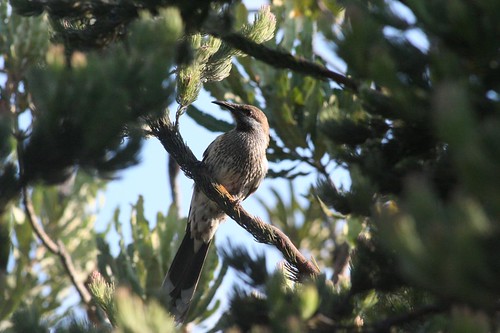
  • Added a few new birds to my life list – most notably a pair of Bush Stone-curlews (Burhinus grallarius) seen on the road to East Intercourse Island in Dampier in the middle of the night (I was on night shift, not going for a midnight twitch);
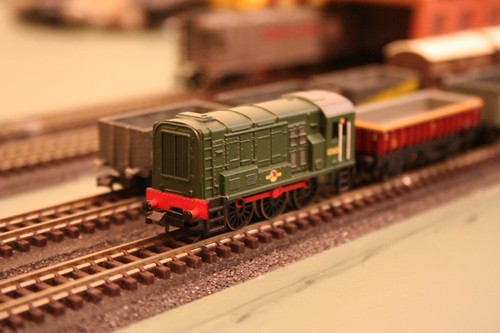
  • Work on my British N Gauge model railway is progressing well (tunnels are under construction, some buildings have been added). The locomotive and rolling stock collection is growing also (I have three Graham Farish locomotives: a Class 08, a Class 31 and a Class 37);
  • I seem to be continually adding Macs (in particular iMacs) to the collection – thanks Alex! Thankfully I have a shed…
Edit: Changed Beach Stone-curlew to Bush Stone-curlew after consultation with experts.

Going with British Diesel

With the acquisition of a Graham Farish BR Class 37 Diesel (37035), I have made the decision to go with British Diesel on my N-gauge model railway.

IMG_3592

There are a lot of reasons to go for American locomotives (reliability and availability being the biggest two) but for some reason I am attracted to the British locomotives.  At some point in the not-to-distant future I may add a shunter to my fleet (probably a Graham Farish one again).
As it turns out, my daughter Olivia (who loves playing trains) has taken a strong disliking to the Class 37 locomotive.  Kylie (my wife) thinks it looks like a slug…
(edit: Kylie claims she called it a caterpillar).

Decisions, decisions…

So, I now have a partially constructed N-gauge model railway.  It is now time to start considering what locomotives and rolling stock to run.  The question is: English or American?

I am leaning towards English (mainly diesel) at the moment.  I like the locomotives more and I can run small consists with some degree of realism (running an American diesel with three box cars just doesn’t look right).  There are other prototypes out there (Japanese is one that comes to mind) but I don’t have much knowledge and experience with them.
A quick tip found out the hard way: I’m sure it has uses but Flex-track is a real pain.  Set-track is much nicer to work with (just a little more expensive).

Thomsons Lake Crakes

Went to Thomsons Lake last week with Martin Cake for a bit of a look.
With Martin’s expertise we saw all three of the common crakes for the area:

  • Baillon’s Crake (Porzana pusilla);
  • Australian Spotted Crake (Porzana fluminea);
  • Spotless Crake (Porzana tabuensis).
They were all seen in the typha at the southern end within a few metres of each other!
Also seen was a tiger snake and a feral fox (inside the perimeter fence at the northern end of the lake).

Red-eared Firetail

My first new sighting for the year!

Red-eared Firetail (Stagnopleura oculata) – a small group (about 4) seen at Lesmurdie Falls. I managed to take some photographs but they were for identification only.

Lesmurdie Falls is local to me now – the birding there is quite good. There is still a fair bit of water flowing and most of the (unburnt) vegetation is thick and green. Also seen:

  • Tawny Frogmouth (Podargus strigoides);
  • Splendid Fairy-wren (Malurus splendens);
  • Common Bronzewing (Phaps chalcoptera).

Hot rod 7500

I have finally finished building (I think) my hot rod Power Mac 7500.  It has:

  • 256MB of RAM (using 4 of the 8 slots in case I find some more 64MB sticks);
  • An IBM 18GB SCSI disk;
  • A PowerLogix PowerForce G3 350/175/512K G3 (Spartan) upgrade card running at 300MHz;
  • A fairly generic USB 1.1 PCI card;
  • An Apple Fast Ethernet 10/100 Base-T PCI card;
  • An iXMicro Ultimate Rez Twin Turbo 128 PCI graphics card;
  • An AppleVision 1710 Display.
Everything else (floppy and CD drive) is stock.  It runs Mac OS 8.6 like lightning.