I am seriously considering building something like this.
Is there anything Lego can’t do?
Leave a reply
I am seriously considering building something like this.
Spent some time tinkering with some old PowerBooks recently:
I think the biggest problem facing people who collect old Macs (in particular PowerBooks) is the internal 2.5″ SCSI disk issue. These invariably fail and are getting harder and harder to find. Ideally, a SCSI to IDE converter should be made (or even a SCSI to CF adapter) but I don’t think this is going to happen. At least with desktop Macs the 3.5″ SCSI drives can be replaced by more modern SCSI drives (with the appropriate adapters).
NSIS (Nullsoft Scriptable Install System) is a fantastic piece of software I have been using to create an installer for a project at work. It is highly customisable and handles both the installing and un-installing of files. From the website:
NSIS (Nullsoft Scriptable Install System) is a professional open source system to create Windows installers. It is designed to be as small and flexible as possible and is therefore very suitable for internet distribution.
The software itself is small and integrates nicely with my favourite (Windows) text editor: NotePad++.
I am on a 5GB/month wireless broadband plan from Optus. For the purposes of selling the plan to you, Optus define 1GB as 1000MB (see screen shot below).
For the purposes of billing you, however, Optus define 1MB as 1024KB (also see the screen shot below). This means that they would define 1GB as 1024 MB for data used. Hence the 5GB plan is actually a (5000/(5 x 1024)) x 5 = 4.88 GB plan.

5GB should give you 5 x 1024MB = 5120MB.
Given that excess usage (not that we are at any risk of that) is charged per MB, not shaped, it would be good if they were consistent.
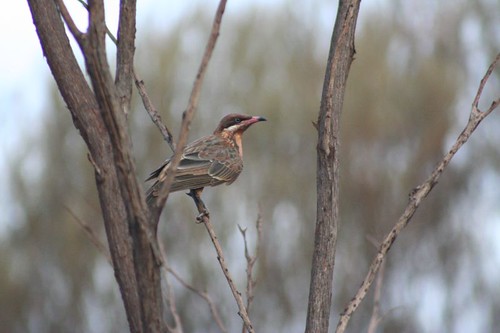
Spiny-cheeked Honeyeater (Acanthagenys rufogularis ) seen near the Rio Tinto West Angelas mine camp (23°07’53.96″ S 118°41’39.18″ E). They were reasonably difficult to find and identify but thankfully I got a few good photos. This is my first new honeyeater for a while.
A (somewhat belated) Happy New Year to all!
Just saw a Pheasant Coucal (Centropus phasianinus) in the Dampier townsite. This is my second sighting; the first was on the Burrup Peninsula (I got some very poor photographs). It is a very impressive bird, and fairly large as well. Alas, I was not carrying my camera…
For further information see here.
One of the software packages I use a lot at work (ProWORX NxT) runs a graphics server (in a 16-bit virtual machine no less). Here is a screen-shot of the about box. For those who don’t know, ProWORX NxT is a PLC programming package.

It works OK under Windows XP.
I am now a GOLD level frequent flyer.
I don’t know whether this is a good or bad thing…
…whether I should upgrade my PowerBook G4 (12″, 1GHz) to Mac OS X Leopard 10.5. I currently have the original 40GB HDD installed, so perhaps I should upgrade that first (given Leopard requires 9GB to install). The G3s I have will all stay at 10.4 for the time being. They are all sub-500MHz so I don’t think any amount of hacking will make 10.5 worthwhile on them.
For the record, I don’t think Apple making the minimum processor required for Leopard to be an 867MHz G4 is unfair. And I have lots of old Macs that can run 10.4 🙂
Edit: I will probably wait for 10.5.1 to come out.